Cacao pods on the tree, Piura, Peru
Heart Magic Cacao

Sourcing &
Supply Chain

Where our cacao comes from, who grows it, and how it gets to your cup.

2026 Edition • heartmagiccacao.com
A note from us

The world of cacao is enormous.
Ours is small and chosen.

Three sources. Two single origin cacaos and one mushroom partner. Everything bought directly from people we know, no commodity blends, no anonymous middlemen, no shortcuts.

This guide walks you through the people, the places, and the path from harvest to your kitchen.

Origin 01 • The desert

From the Tropical Desert,
Piura, Peru

The cacao for our discs

This is the cacao we use in our Heart Magic Discs. Sourced from small family farms in the Morropón valleys of Piura, on Peru's northern coast, in the heart of the Sechura Desert. One of the most unlikely places on Earth for cacao to grow: just 5° south of the equator where you'd expect jungle, but instead sand, wind, and almost no rain.

The Andes block moisture from the Amazon; the cold Humboldt Current keeps rain clouds from forming. Yet cacao has thrived here for over a thousand years, fed by narrow rivers from the Andes, cultivated by farming families who pass white cacao genetics from one generation to the next.

A note to new cacao connoisseurs: Tropical Desert is our most complex origin. Its bright, fruit forward profile reads almost like wine, that brightness is a sign of quality, not a flaw. White cacao genetics produce lower tannins and a cleaner, more delicate cup.

White cacao, under 0.1% of the world's cacao

Adapted over centuries to desert conditions, the Piura white bean uses ten times less water than jungle cacao. Fewer insects meant less need for tannin defense, which is why the beans are pale cream rather than purple, and why the cup tastes naturally bright and low in bitterness.

Desert Adapted
10x less water than jungle cacao. One of the most drought resistant varieties on Earth.
White Beans
Pale, cream colored beans from naturally reduced tannins. Less bitterness, more brightness.
Genetic Rarity
Less than 0.1% of world cacao. Geographic isolation has preserved this variety for generations.
1,000+ Years
Cultivated in the Sechura desert long before specialty chocolate makers discovered it.

Origin & terroir

Region
Morropón, Piura, Peru
Altitude
130–140 m
Climate
Dry, tropical, warm year round
Varietal
Native Piura white cacao
Flavor
Bright passion fruit, mango, citrus
Harvest
April–October
Origin 02 • The jungle

From the Peruvian Amazon,
the high jungle

The cacao for our hearts

This is the cacao we use in our Heart Magic Hearts. Sourced from smallholder family farms in the high jungle valleys of the Peruvian Amazon, the corridor where the Andes descend into the Amazon basin, through our direct partnership with Terra Nostra Organics. Cacao that tastes unmistakably like chocolate.

Grown in true agroforestry, alongside fruit trees and a canopy of native shade, the way the rainforest itself layers. Certified Organic, Fair Trade, and Regenerative Organic. No clearing. No monoculture. No chemicals.

A note to new cacao connoisseurs: If Tropical Desert is the wine of cacao, Amazon Jungle is the bread. Grounding, rich, unmistakably cacao. If you're new to ceremonial cacao, start here.
Native Varietals
Heirloom fine flavor cacao native to the upper Amazon. Naturally lower in bitterness, deep chocolate forward profile.
Agroforestry
Multi strata farms with native shade canopy and other crops, the way the rainforest layers.
Regenerative Organic
Certified Organic, Fair Trade, and Regenerative Organic. Native seedlings distributed to farmers.
7% Wild
At least 7% of every farm left uncultivated, preserved as native rainforest.

Origin & terroir

Region
High jungle valleys, Peruvian Amazon
Altitude
300–900 m
Climate
Tropical, humid, warm and rainy
Varietal
Native Peruvian fine flavor heirloom varietals
Flavor
Deep cocoa, raisin, fig, warm spice
Harvest
Main: Apr–Sep • Secondary: Oct–Dec

Genetic studies trace cacao itself to the upper Amazon, the place the plant came from.

Our mushroom partner

Nammex, pioneers of
certified organic medicinal mushrooms

Our mushroom extracts come from Nammex, a Vancouver based company that has been pioneering certified organic mushroom extracts since 1989, longer than almost anyone in the industry.

Founded by Jeff Chilton, a commercial mushroom grower who began his career in 1973 and co authored one of the bestselling cultivation guides of the 1980s. In 1996, Chilton traveled to China to organize certified organic mushroom production with growers in the mountains who'd been cultivating these mushrooms for centuries. Those partnerships are still the source of every Nammex mushroom today, grown in shaded greenhouses with deep well water, natural sunlight, and protein enriched sawdust or hardwood logs. Wild Chaga is wildcrafted from boreal birch forests where it's been used for hundreds of years.

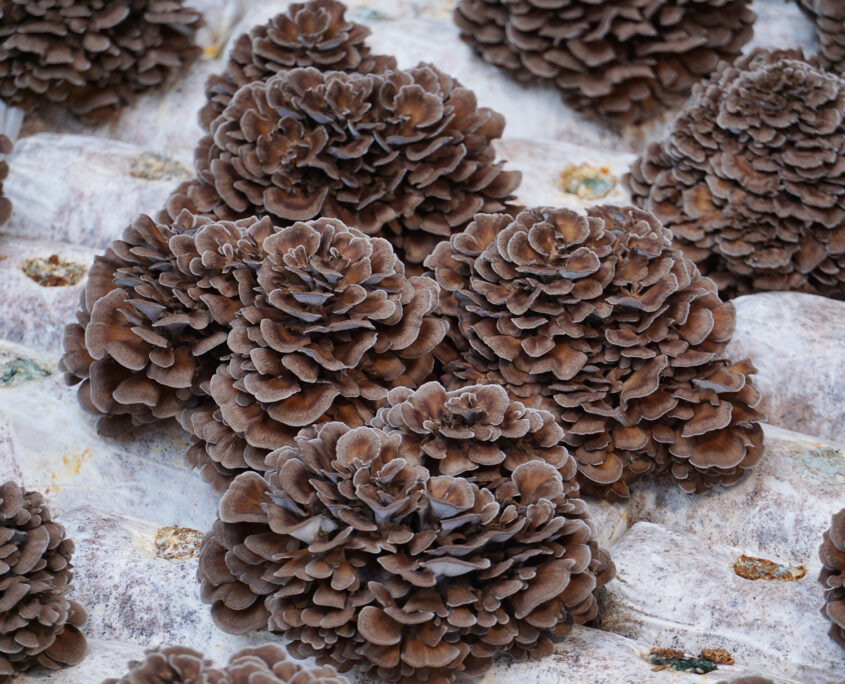
The six mushrooms we use: Chaga, Lion's Mane, Cordyceps militaris, Reishi, Golden Oyster, and MycoD₂ (UV activated maitake). Detailed health benefits and synergy with cacao are covered on a separate page.

Whole fruiting bodies. Not mycelium on grain.

This is the most important sourcing distinction in the medicinal mushroom industry. Most "mushroom" supplements on U.S. shelves aren't mushrooms, they're mycelium grown on grain like oats or rice, with the grain not separated out. The result: a powder that's mostly grain, with low beta glucan, very high starch, and undetectable levels of the secondary compounds that matter.

A real extract uses the fruiting body, the actual mushroom, hot water extracted to concentrate the actives. That's what Nammex does. Every batch is independently HPLC tested.

Certified Organic Since 1996
Predating most of the modern medicinal mushroom industry by more than a decade.
HPLC Tested Per Batch
Beta glucan, triterpenes, ergosterol verified. Test results guaranteed, not aspirational.
Fruiting Bodies Only
Never mycelium on grain. The actual mushroom, the part with the active compounds.
Direct Partnership
Long standing relationship with a supplier whose standards are widely cited as the industry benchmark.

The six mushrooms in our blends

Chaga mushroom
ChagaInonotus obliquus
Lion's Mane mushroom
Lion's ManeHericium erinaceus
Cordyceps mushroom
CordycepsCordyceps militaris
Reishi mushroom
ReishiGanoderma lucidum
Golden Oyster mushroom
Golden OysterPleurotus citrinopileatus
MycoD2 maitake mushroom
MycoD₂UV activated maitake
Heavy metals testing

What is (and isn't)
inside our cacao

Every batch of Heart Magic cacao undergoes third party heavy metals analysis. Our levels are under the California Prop 65 limits, among the lowest detectable traces of any ceremonial cacao on the market.

Below
CA Prop 65 Limits
Every Lot
Third Party Tested
100%
Cacao + Mushrooms
No Additives

What's in it

100% cacao paste, no additives, no emulsifiers, no alkalization, no fillers. Our blends include other ingredients like spices, tahini, and rose powder. Every additional ingredient we use is organic and sourced to the highest standard.

Honest transparency, not perfection. Cacao is a living product. Trace elements like cadmium and lead can naturally occur in cacao soils, true of many whole foods. We use EU and California limits as reference points, but go further: every individual lot is reviewed, not just averages. Our role is not to remove what is natural, but to choose with care, test with rigor, and share openly.

Purity begins at origin

Soil & Origin
We choose regions and lots with intention, guided by long term relationships on the ground.
Farmer Training
We work side by side with producers on fermentation, drying, and handling.
Drying & Storage
Careful drying and proper storage, for both flavor and reduced contamination.

Want to see a recent lab report? Write to us, we'll send the documentation directly.

From tree to cup

Our supply chain,
step by step

Both origins follow the same fundamental path. Timing varies, the desert dries fast, the jungle dries slow. The principles don't.

Cacao beans drying on raised beds
1
Harvest • Apr–Oct (Piura) • Apr–Dec (Amazon)
Pods cut from the tree by hand
Each pod harvested individually. Wrong color or feel and the pod stays on the tree. No machine does this.
2
Same day
Cracked open, wet beans extracted
Pods split with a machete; pulp covered beans scooped out by hand and straight into fermentation.
3
5–7 days
Fermentation in wooden boxes
Beans layered into cascading boxes and turned daily. Wild yeasts develop the flavor. The single most important step.
4
Piura: 7–10 days • Amazon: 10–14 days
Sun dried on raised beds
Spread on raised beds, dried by the sun to ~7–8% moisture. Desert dries fast; jungle dries slow under tarps.
5
After drying
Hand sorted, bagged, shipped
Hand sorted, packed in 60–70 kg jute sacks, ocean shipped from Paita or Callao.
6
In our kitchen
Stone ground into paste
Warm gently, winnow the husks, stone grind into pure cacao paste. Nothing added, nothing removed.
7
For mushroom blends
Mushroom extracts blended in
Hand blended Nammex extracts into the warm paste at label disclosed doses. No fillers.
8
Packaged by hand
Hand poured, weighed, labeled, shipped
The same hands that opened the sack pack your order.
Honor and connection

Ethically sourced,
directly traded

We work directly with small family farming communities in both cacao origins. By paying more than double the usual wages and maintaining direct trade relationships, we help them preserve rare cacao varieties the rest of the world is only beginning to understand.

Path through the cacao plantation

Premium pay, above commodity

Our farmers and cooperatives earn meaningfully more than the New York price.

Long term relationships, not transactions

Same partners year after year, continuity that lets cooperatives invest in their farms.

No middlemen between us and the source

We know the cooperatives, agronomists, ports, and lot numbers. Every step is a person we can call.

The land matters as much as the beans

A desert ecosystem holding a rare genetic line. A rainforest holding the original home of cacao.

Closing

Three sources. One philosophy.

Whether you choose our discs or heart blends, you're reaching for ingredients grown by people we know, on land that was cared for, processed with the time it takes to do well.

Questions about a specific batch or want a recent lab report? Write to us. We answer.

Jacob and Marco at the cacao farm

Ready to experience it yourself?

Ceremonial cacao and 6 functional mushrooms, sourced the way you've just read about.

Shop Heart Magic

Subscribe and save. No commitment, cancel anytime.

10% off subscription · 30-day guarantee · Free shipping